Creator Storefront Platform Built for Influencer Agencies
Influencer agencies manage dozens — sometimes hundreds — of creator relationships simultaneously, each with unique brand partnerships, content deliverables, and revenue targets. The challenge is not just managing creators but monetizing their influence at scale. Creator storefronts give agencies the infrastructure to turn every creator in their roster into a shoppable sales channel, bridging the gap between content creation and measurable commerce outcomes.
Storefront monetization for influencer networks is no longer optional. Brands expect agencies to deliver full-funnel results, from awareness through conversion. Social commerce has shifted the economics of influencer marketing: it is not enough to report on impressions and engagement rates when clients want to see revenue attribution, average order values, and return on creator spend. Agencies that cannot offer storefront capabilities risk losing contracts to competitors who can.
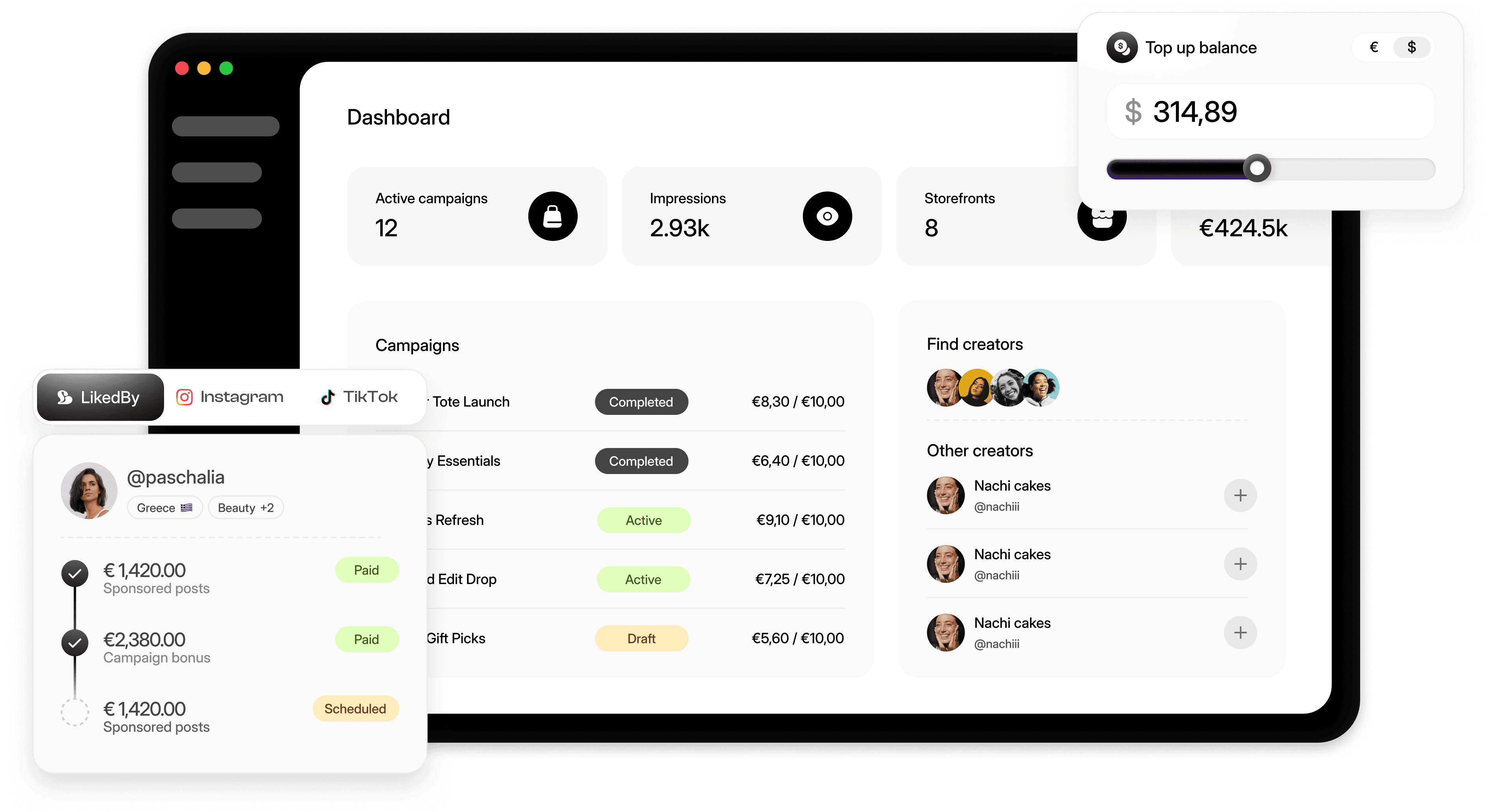
Socialscale provides the operating system that influencer agencies need to launch, manage, and optimize creator storefronts across their entire network. From onboarding creators and assigning product catalogs to embedding shoppable content and tracking per-creator revenue, the platform handles the operational complexity so agency teams can focus on strategy and growth.
Core Challenges Facing Influencer Agencies in Storefront Monetization
Agencies operating creator programs at scale encounter a specific set of operational and strategic obstacles when attempting to monetize through storefronts. These are not hypothetical — they are the daily friction points that slow down campaigns and erode margins.
1. Fragmented Creator Onboarding Across Multiple Brands
Agencies typically represent multiple brands, each with different product lines, commission structures, and compliance requirements. Onboarding creators into storefront programs for each brand individually creates duplicated effort and inconsistent experiences. Without a centralized system, agency coordinators spend hours manually configuring each creator-brand pairing.
2. No Unified View of Creator Commerce Performance
Most agencies cobble together analytics from affiliate networks, social platform insights, and e-commerce dashboards. This means there is no single source of truth for how a creator's storefront is performing. Revenue attribution becomes guesswork, and reporting to clients takes days instead of minutes.
3. Content-to-Commerce Disconnect
Creators produce content, but that content often lives in social feeds with no direct path to purchase. Agencies struggle to bridge the gap between a creator's Instagram Reel or TikTok video and a shoppable product page. The result is lost conversion potential and an inability to prove ROI to brand clients.
4. Manual Product Catalog Management
Assigning the right products to the right creators — based on niche, audience demographics, and brand fit — is a manual process in most agencies. When product catalogs change (new launches, seasonal rotations, discontinued SKUs), updating every creator's storefront becomes a logistical nightmare.
5. Inconsistent Commission Tracking and Payouts
Agencies running affiliate creator programs across multiple brands often deal with different commission tiers, bonus structures, and payout schedules. Without automation, reconciling earnings per creator per brand per campaign is error-prone and time-consuming.
6. Scaling Storefront Programs Beyond a Handful of Creators
What works for 10 creators breaks at 100. Agencies that manually manage storefronts hit a ceiling where adding more creators actually decreases operational efficiency. The lack of templatized workflows and bulk management tools prevents growth.
7. Client Reporting That Lacks Commerce Depth
Brand clients increasingly demand commerce-level reporting: GMV per creator, conversion rates by content type, revenue per storefront visit. Agencies relying on vanity metrics lose credibility and contract renewals.
Why Traditional Influencer Marketing Tools Fall Short
Affiliate Platforms Were Not Built for Agency Workflows
Traditional affiliate networks like ShareASale or CJ handle link tracking and commissions, but they offer no creator management, content organization, or storefront customization. Agencies end up using them as one of five or six disconnected tools, with no way to manage the full creator lifecycle in one place.
Influencer Marketing Platforms Focus on Discovery, Not Commerce
Tools like Grin, CreatorIQ, or Aspire excel at creator discovery and campaign management but lack native storefront functionality. They can help you find and brief creators, but they cannot turn that creator's content into a shoppable experience embedded on a brand's website or a dedicated storefront page. The commerce layer is missing entirely.
E-commerce Platforms Do Not Understand Creator Relationships
Shopify and similar platforms power the transactional side, but they have no concept of creator-specific storefronts, per-creator analytics, or content-driven product pages. Agencies cannot assign products to creators, track creator-attributed revenue, or manage UGC assets within an e-commerce backend.
Spreadsheets and Manual Processes Create Bottlenecks
Many agencies still coordinate storefront programs through spreadsheets, Slack messages, and email threads. Product assignments, content approvals, commission calculations, and performance reviews all happen in disconnected systems. This approach does not scale and introduces errors that damage client relationships.
No Single Platform Connects Content, Commerce, and Creator Management
The fundamental problem is that no traditional tool category — affiliate, influencer marketing, e-commerce, or project management — covers the full scope of what agencies need for storefront monetization. Agencies are forced into a patchwork of tools that do not share data, creating blind spots and operational drag.
How Socialscale Solves Storefront Monetization for Influencer Agencies
Socialscale is purpose-built as a creator marketing platform that unifies creator management, content operations, and social commerce into a single system. For influencer agencies, this means you can onboard creators, assign them to brand storefronts, manage product catalogs, collect and organize UGC, embed shoppable content, and track per-creator revenue — all without switching between tools.
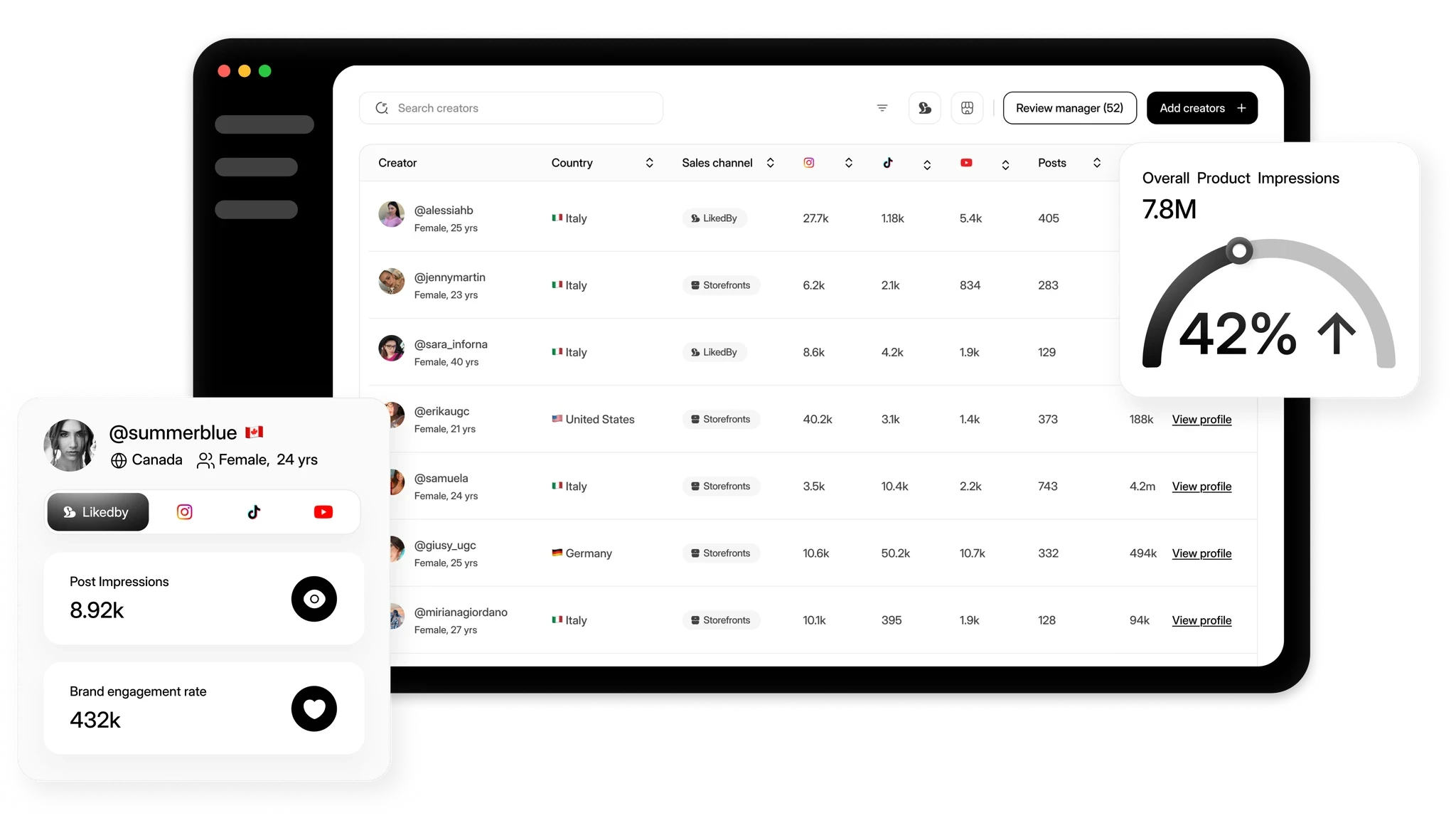
The platform's creator CRM gives agency teams a centralized database of every creator in their network, complete with brand assignments, contract status, content history, and commerce performance. When a new brand client comes on board, agencies can quickly identify which creators in their roster are the best fit, assign them products, and launch storefronts in days rather than weeks.
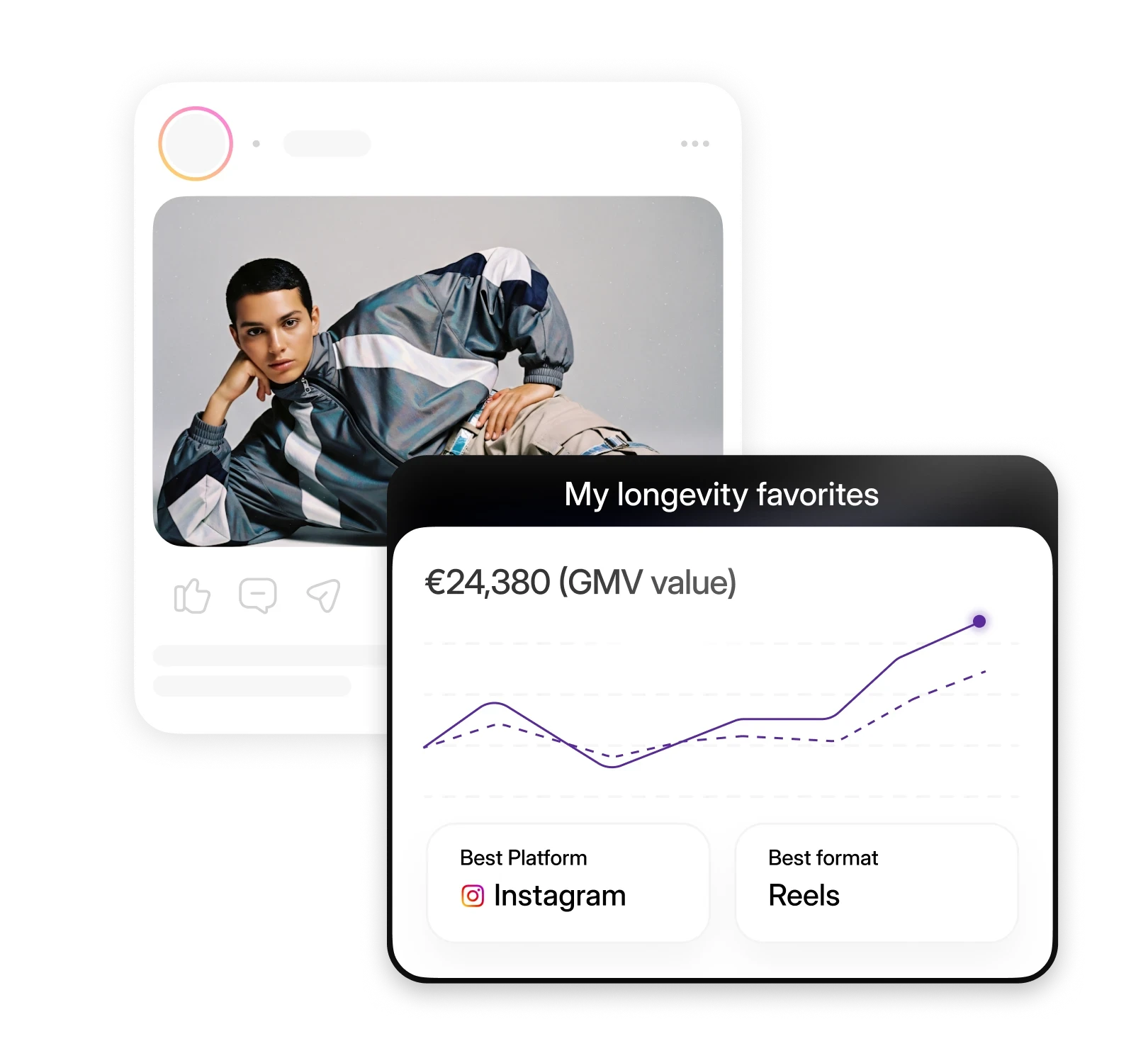
On the commerce side, Socialscale's creator widgets allow agencies to embed shoppable creator content directly on brand websites, product pages, and dedicated storefront landing pages. Each widget is tied to a specific creator, so every click, add-to-cart, and purchase is attributed back to the individual creator. This gives agencies the commerce-level reporting that brand clients demand, while giving creators visibility into their own performance and earnings.
For content operations, the platform includes a centralized asset library where all creator-generated content is stored, tagged, and organized by brand, campaign, product, and content type. Agency teams can review, approve, and repurpose UGC without chasing creators for files or digging through cloud storage folders.
Feature Breakdown: Creator Storefronts for Agency Operations
Multi-Brand Creator Onboarding
Agencies can onboard creators into multiple brand programs from a single interface. Each creator profile stores brand-specific details — assigned products, commission tiers, content guidelines, and storefront configurations. Bulk onboarding tools let agencies add dozens of creators to a new brand program simultaneously, with customizable intake forms that capture the information each brand requires.
Product Catalog Assignment and Management
Synced product catalogs allow agencies to assign specific products or collections to individual creators or creator segments. When a brand launches a new product or discontinues an SKU, the catalog updates propagate to all associated creator storefronts automatically. Agencies can also create curated product sets — for example, assigning summer skincare bundles to beauty creators and activewear collections to fitness creators.
Shoppable Creator Content Widgets
Each creator's storefront can feature shoppable content widgets that display their UGC alongside the products they are promoting. These widgets are embeddable on brand websites, landing pages, or standalone storefront URLs. The content is clickable and leads directly to purchase, closing the loop between creator content and commerce. Agencies control which content appears, ensuring brand compliance before anything goes live.
Per-Creator Revenue Attribution
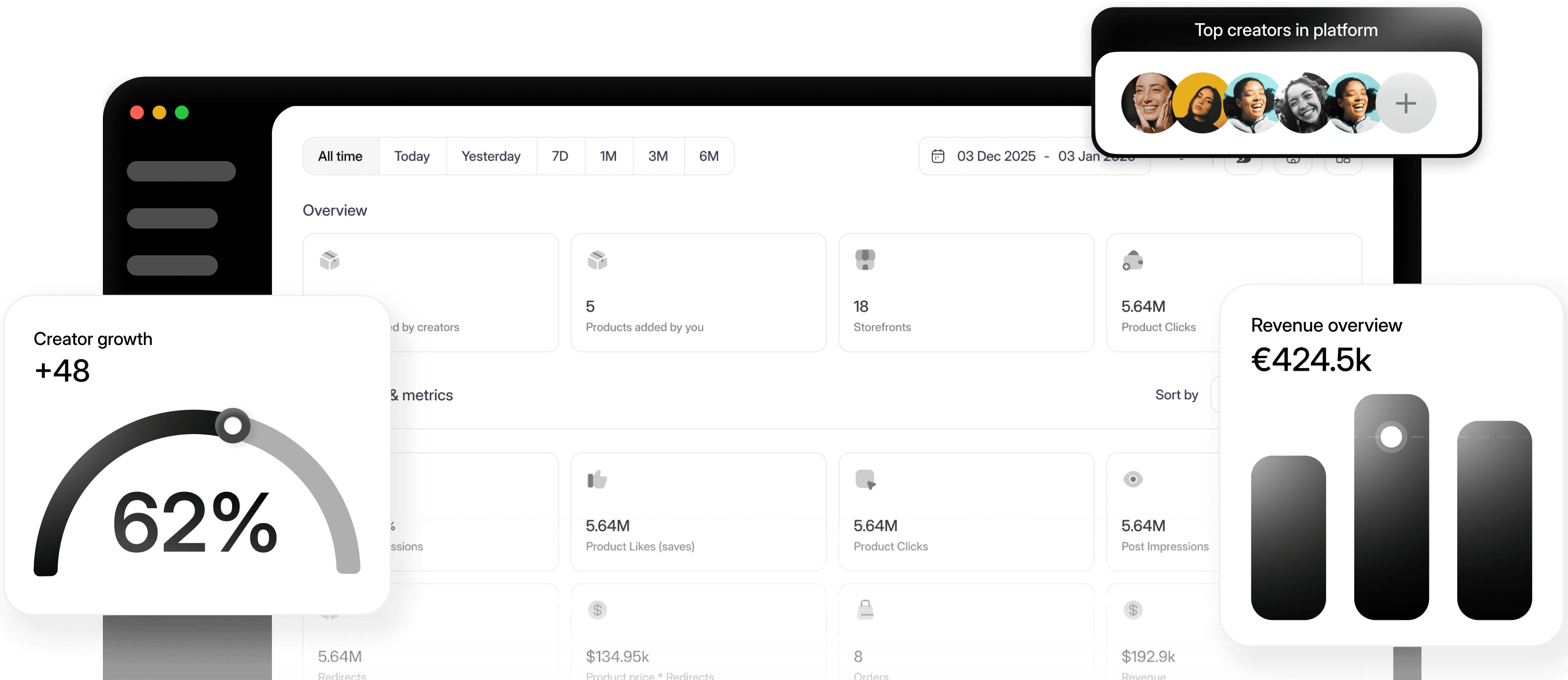
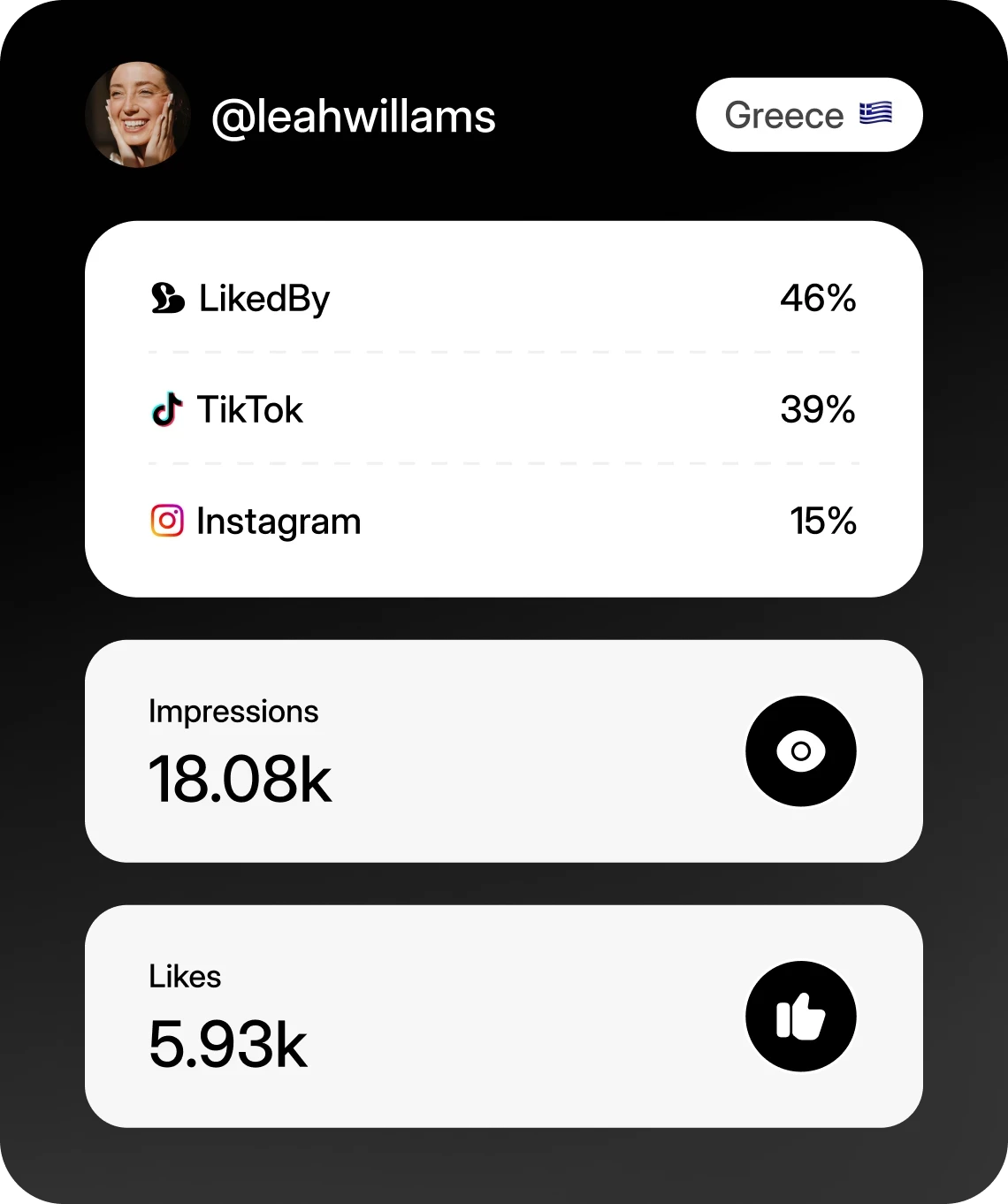
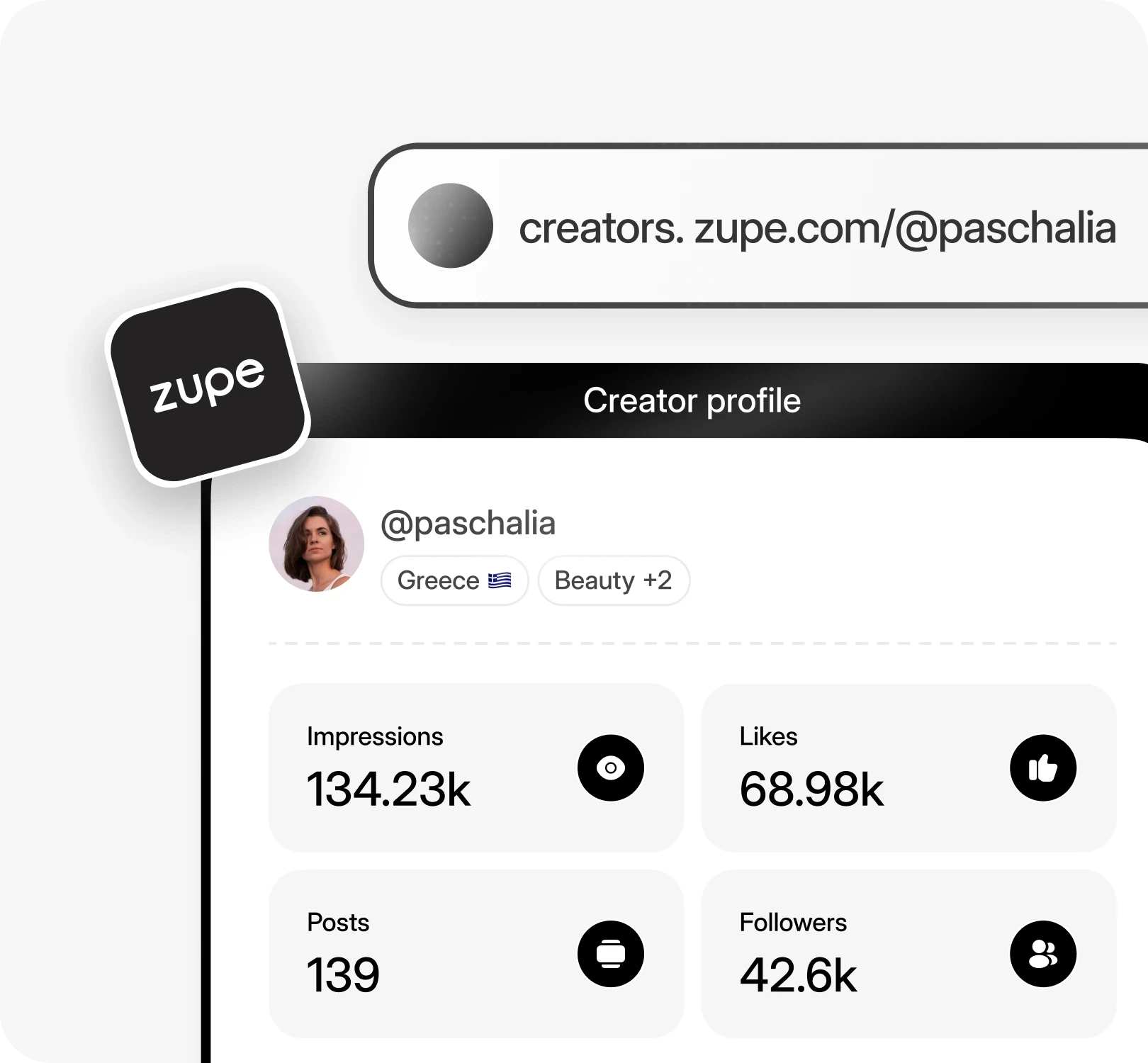
Every transaction that originates from a creator's storefront or shoppable widget is tracked and attributed to that creator. Agencies can see revenue, conversion rate, average order value, and click-through rate at the individual creator level. This data feeds into client reports and informs decisions about which creators to scale, which to re-brief, and which to sunset.
Creator Performance Dashboards
Agency teams get access to creator analytics dashboards that aggregate performance across all brands and campaigns. Filters allow drilling down by brand, creator tier, content type, product category, or time period. Creators themselves can access a simplified view of their own performance, reducing the volume of inbound questions about earnings and metrics.
Content Library and UGC Management
All creator content — photos, videos, stories, reels — is collected and stored in a centralized content drive. Assets are automatically tagged by creator, brand, campaign, and product. Agency teams can search, filter, and download content for repurposing across paid media, email, and owned channels. Rights management is built in, so agencies always know which content they have permission to use and where.
Campaign and Collaboration Management
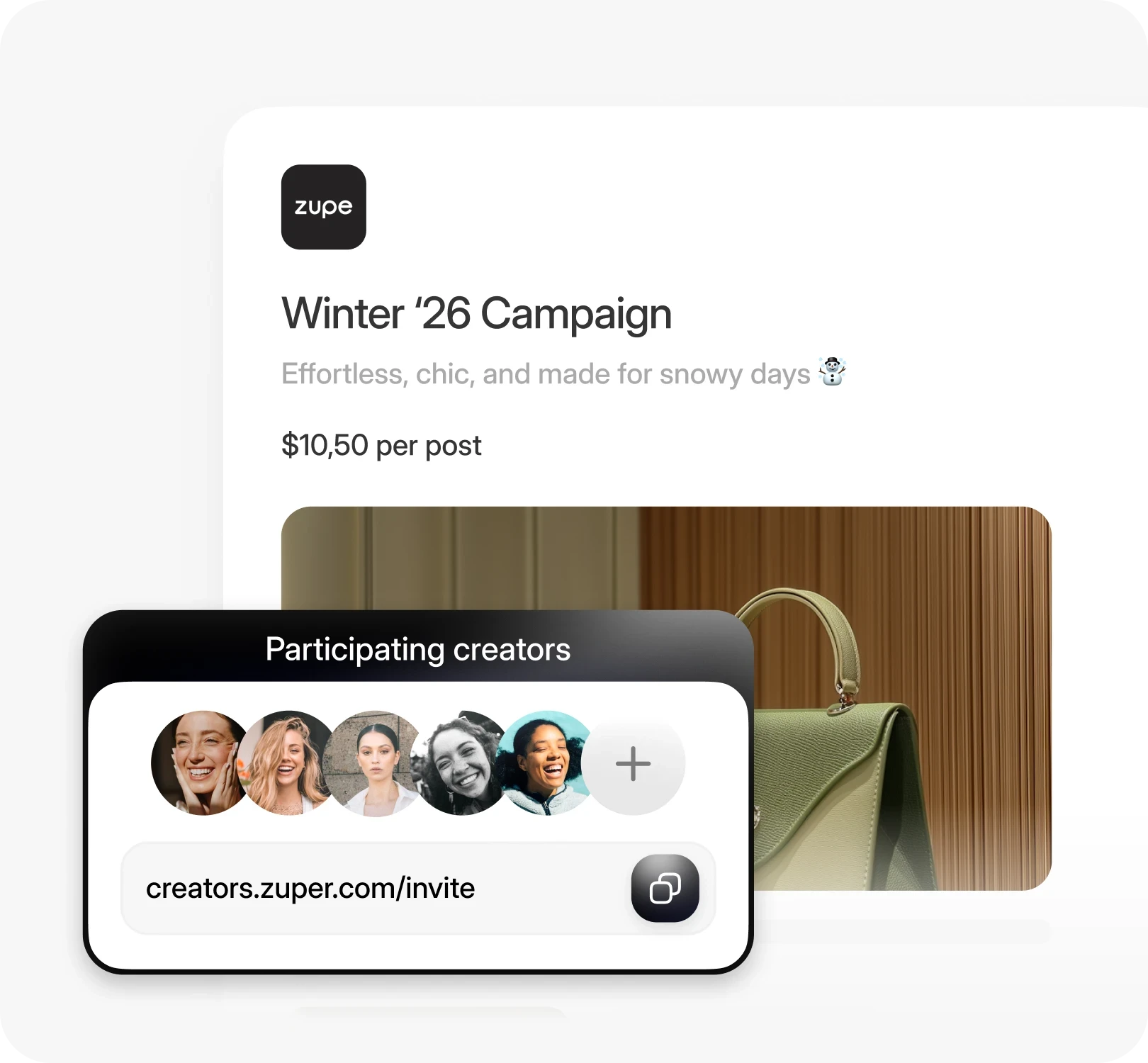
Agencies can create campaigns within the platform, assign creators, set deliverables and deadlines, and track completion status. Each campaign can be tied to specific storefront promotions — for example, a holiday gift guide campaign where each creator curates their top picks into a shoppable storefront page. This keeps campaign execution and storefront monetization tightly integrated.
Use Cases: Creator Storefronts in Influencer Agency Operations
1. Multi-Brand Holiday Storefront Campaign
An influencer agency managing 15 beauty and lifestyle brands launches a coordinated holiday campaign. Each of the agency's 200 creators receives a personalized storefront featuring curated gift sets from the brands they represent. Creators share their storefront links across Instagram Stories, TikTok bios, and YouTube descriptions. The agency tracks real-time revenue per creator per brand, identifies top performers mid-campaign, and reallocates promotional budget to amplify the highest-converting storefronts. Post-campaign, the agency delivers brand-by-brand revenue reports showing exact GMV attributed to each creator.
2. Always-On Affiliate Storefront Program
Rather than running one-off campaigns, an agency establishes permanent creator storefronts for a DTC fashion brand. Fifty mid-tier creators each maintain a storefront page featuring their favorite products, updated quarterly as new collections drop. The agency monitors monthly storefront traffic, conversion rates, and revenue trends. Creators who consistently drive sales receive higher commission tiers and early access to new products. The program runs continuously with minimal agency overhead because product catalog updates and performance tracking are automated.
3. Product Launch Amplification Through Creator Storefronts
A consumer electronics brand partners with an agency to launch a new product line. The agency activates 30 tech creators, each receiving the product for review. Alongside their review content, each creator gets a dedicated storefront page featuring the new product with exclusive early-access pricing. The agency embeds shoppable widgets on the brand's product launch landing page, showcasing creator reviews alongside buy buttons. The combination of authentic creator content and frictionless purchase paths drives a measurable spike in launch-week sales.
4. Regional Storefront Segmentation for Global Brands
An agency working with a global sportswear brand segments its creator network by region — North America, Europe, and Asia-Pacific. Each regional creator cohort receives storefronts featuring products available in their market, with localized pricing and shipping information. The agency runs region-specific campaigns tied to local sporting events and cultural moments. Performance data is segmented by region, allowing the brand to compare creator-driven revenue across markets and adjust investment accordingly.
Weekly and Monthly Operational Workflow for Agency Storefront Programs
Running a creator storefront program at agency scale requires structured, repeatable processes. Below is a practical workflow that agency teams can follow to keep programs running efficiently.
Creator Intake and Brand Matching (Monthly)
Review new creator applications and existing roster availability. Match creators to brand programs based on audience demographics, content style, niche alignment, and past performance. Use the creator CRM to tag creators by brand assignment and storefront eligibility. Complete onboarding for newly matched creators, including product shipments and storefront setup.
Product Catalog Updates (Bi-Weekly or As Needed)
Sync product catalogs from brand Shopify stores. Assign new products or collections to relevant creator storefronts. Remove discontinued or out-of-stock items. Notify creators of new products available for promotion through in-platform messaging.
Content Collection and Approval (Weekly)
Review incoming creator content submissions. Approve or request revisions based on brand guidelines. Approved content is automatically added to the content library and becomes eligible for storefront widget display. Flag high-performing content for paid media repurposing.
Storefront Content Refresh (Weekly)
Update shoppable widgets with newly approved creator content. Rotate featured products based on campaign priorities or seasonal relevance. Ensure all storefront links are active and product information is accurate.
Performance Monitoring (Weekly)
Review creator-level and storefront-level analytics: clicks, conversions, revenue, and average order value. Identify underperforming storefronts and diagnose issues — low traffic, poor content quality, mismatched products. Flag top performers for bonus incentives or expanded product assignments.
Creator Communication and Re-Briefing (Weekly)
Send performance summaries to creators with actionable feedback. Re-brief creators whose storefronts are underperforming with updated product recommendations or content direction. Share top-performing content examples as benchmarks for the network.
Client Reporting (Monthly)
Generate brand-specific reports showing total storefront GMV, per-creator revenue breakdown, content output volume, conversion rates, and ROAS. Include content samples and highlight top-performing creators. Use reports to justify program continuation, expansion, or budget increases.
Program Optimization (Monthly)
Analyze month-over-month trends across the creator network. Adjust commission structures, product assignments, and creator tiers based on data. Sunset non-performing creators and onboard replacements. Test new storefront formats — video-first widgets, curated collections, seasonal themes — and measure impact.
Key Performance Indicators for Agency Storefront Programs
Tracking the right metrics ensures agencies can demonstrate value to brand clients and continuously optimize their creator storefront programs. The following KPIs should be monitored at the creator, campaign, and program levels.
Creator Activation Rate: Percentage of onboarded creators who have published storefront content and generated at least one click within the first 14 days.
Content Approval Turnaround Time: Average hours from content submission to agency approval. Faster approvals mean fresher storefront content.
Content Output per Creator: Number of approved content pieces per creator per month, segmented by format (photo, video, story).
Storefront Click-Through Rate (CTR): Ratio of storefront impressions to clicks, measured across embedded widgets and direct storefront links.
Conversion Rate (CVR): Percentage of storefront visitors who complete a purchase. Tracked per creator and per product to identify high-converting pairings.
Gross Merchandise Value (GMV): Total revenue generated through creator storefronts, reported per creator, per brand, and per campaign.
Revenue per Creator: Average and median GMV per active creator, used to benchmark performance and set commission tiers.
Return on Creator Spend (ROAS): Total storefront revenue divided by total creator costs (fees, commissions, product seeding). The primary metric for proving program profitability to brand clients.
Cost per Acquisition (CPA): Total program cost divided by number of storefront-attributed orders. Compared against brand benchmarks for paid media CPA.
Average Order Value (AOV): Average transaction value from storefront purchases, tracked per creator to identify who drives premium purchases.
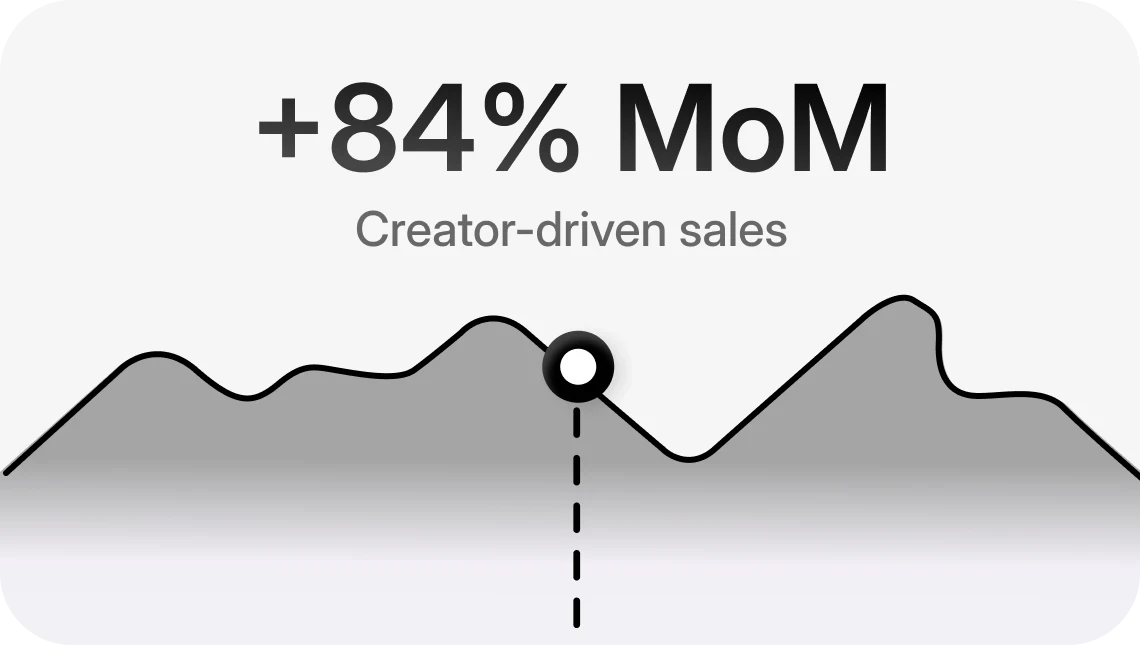
Storefront Revenue Growth (Month-over-Month): Trend metric showing whether the program is scaling effectively or plateauing.
Agency Scenario: Scaling Storefront Revenue for a DTC Skincare Brand
A mid-size influencer agency managing 12 brand clients onboarded a DTC skincare brand that had previously run influencer campaigns through one-off gifting and discount codes. The brand's existing approach generated awareness but had no reliable way to attribute sales to individual creators or measure commerce ROI.
The agency migrated the brand's creator program onto a centralized storefront platform. Within the first two weeks, the team onboarded 45 skincare and beauty creators from their existing roster. Each creator received a personalized storefront page featuring their recommended products from the brand's Shopify catalog. The agency's content team reviewed and approved initial batches of creator content, which were embedded as shoppable widgets on the brand's website and on each creator's storefront page.
Over the first 90 days, the program delivered measurable results:
45 creators activated with storefronts live within 14 days (100% activation rate)
312 pieces of approved UGC collected and organized in the content library
Average content approval turnaround reduced from 72 hours to 8 hours
Storefront CTR averaged 4.7% across all creators
Conversion rate from storefront visits to purchase: 3.2%
Total GMV attributed to creator storefronts: $187,000 in 90 days
Average revenue per creator: $4,155 per quarter
ROAS on total creator program spend (commissions + product seeding): 6.8x
CPA from storefront-attributed orders was 41% lower than the brand's paid social CPA
The brand renewed its agency contract for 12 months and increased the creator budget by 60%. The agency expanded the program to 80 creators in the second quarter, using performance data from the first cohort to identify the creator profiles and content formats that drove the highest conversion rates.
Frequently Asked Questions
How does a creator storefront platform differ from a standard affiliate program?
A standard affiliate program provides tracking links and commission payouts but offers no storefront experience, content management, or visual commerce layer. A creator storefront platform gives each creator a dedicated, branded shopping page featuring their curated products and shoppable content. It combines the attribution of affiliate tracking with the merchandising power of a personalized shopping experience, while also centralizing content operations and creator management for the agency.
Can agencies manage storefronts for multiple brand clients within one platform?
Yes. Socialscale is designed for multi-brand agency operations. Each brand client has its own product catalog, creator assignments, campaign workflows, and reporting. Agency teams can switch between brand accounts without logging into separate tools, and creators who work with multiple brands through the same agency have unified profiles with brand-specific storefront configurations.
How are creator commissions and revenue tracked per storefront?
Every storefront and shoppable widget is tied to a specific creator. When a customer clicks through a creator's storefront and completes a purchase, the transaction is attributed to that creator with full order details — products purchased, order value, and timestamp. Commission calculations are automated based on the rules the agency sets for each brand program, whether that is a flat percentage, tiered rates based on volume, or product-specific commissions.
What types of content can be displayed on creator storefronts?
Creator storefronts can feature photos, short-form videos, long-form video thumbnails, Instagram Reels, TikTok clips, and static product imagery. The shoppable widgets support multiple content formats and can be configured to prioritize video, gallery layouts, or single-product features. All content must pass through the agency's approval workflow before appearing on a storefront.
How long does it take to launch a creator storefront program for a new brand client?
For agencies with an existing creator roster, a storefront program can be operational within one to two weeks. This includes connecting the brand's product catalog, configuring commission structures, onboarding creators, collecting initial content, and embedding shoppable widgets. Agencies starting with a new creator recruitment phase should plan for three to four weeks to allow for creator vetting, onboarding, and initial content production.