Creator Drive for Performance Agencies: Centralized Asset Management for Performance UGC Testing
Performance agencies live and die by creative velocity. Every week, your media buyers need fresh UGC variations to test across paid channels, and every week, your creative ops team scrambles to locate the right assets, match them to the right campaigns, and confirm usage rights. When you manage dozens of creator relationships across multiple client accounts, the asset chaos compounds fast.
Creator Drive was built to solve this exact problem. It gives performance agencies a centralized, searchable content library where every piece of creator content is automatically organized by creator, client, campaign, content type, and approval status. No more digging through Google Drive folders, Slack threads, or email attachments to find that one vertical video a creator delivered three weeks ago.
In the broader context of social commerce, where shoppable content and creator storefronts drive measurable revenue, having instant access to high-performing assets is not a nice-to-have. It is the operational backbone that separates agencies scaling profitably from those burning hours on file management. Creator Drive connects your content pipeline directly to your testing workflow, so your team spends time optimizing performance instead of hunting for files.
Asset Fragmentation Across Clients and Creators
Performance agencies typically manage content from 50 to 500+ creators across multiple client accounts simultaneously. Assets arrive via email, Google Drive links, WeTransfer, Dropbox, and DMs. Without a unified system, creative files scatter across platforms, making retrieval slow and error-prone.
No Connection Between Assets and Performance Data
Media buyers need to know which creative variations drove the best CPA or ROAS. But when assets live in generic cloud storage, there is no link between the file and its performance metrics. Teams waste time cross-referencing ad manager dashboards with folder names.
Usage Rights and Approval Bottlenecks
Every asset has a usage window, and performance agencies must track whether content is approved for paid amplification, organic posting, or whitelisting. Missing an expiration date or running unapproved content creates legal exposure and damages client trust.
Slow Creative Turnaround Kills Test Velocity
Performance campaigns require constant creative refreshes. When it takes your team 45 minutes to locate, verify, and hand off a single asset to a media buyer, your testing cadence drops. Agencies that cannot maintain high creative throughput lose competitive edge.
Version Control Nightmares
Creators often submit multiple revisions. Without clear version tracking, teams risk running outdated or unapproved cuts in live campaigns. This leads to wasted ad spend and client escalations.
Scaling Creator Programs Without Scaling Headcount
As agencies win new clients, the volume of UGC assets grows exponentially. Hiring more coordinators to manage files is not sustainable. Agencies need systems that scale without proportional headcount increases.
Client Reporting Requires Content Visibility
Clients want to see what content was produced, what is in the pipeline, and what performed. Generating these reports manually from scattered folders eats into account management hours that should be spent on strategy.
Google Drive and Dropbox Were Not Built for Creator Content
Generic cloud storage tools have no concept of a creator, a campaign, or a usage right. You end up building elaborate folder hierarchies that break the moment a creator works across multiple clients or campaigns. Search is limited to file names, and there is no metadata layer connecting content to performance outcomes.
Project Management Tools Track Tasks, Not Assets
Tools like Asana, Monday, or Notion can track whether a deliverable was submitted, but they do not function as a content library. You cannot preview, filter, tag, or organize visual assets at scale inside a project management board. The asset itself still lives somewhere else.
DAM Platforms Are Overbuilt and Underspecialized
Enterprise digital asset management platforms like Bynder or Brandfolder are designed for brand teams managing polished campaign assets. They lack creator-specific metadata, UGC approval workflows, and integration with creator CRM or collaboration tools. The licensing costs alone make them impractical for most performance agencies.
Spreadsheets and Manual Trackers Break at Scale
Many agencies start with a spreadsheet linking to files in various locations. This works for five creators. At fifty creators across four clients, the spreadsheet becomes a liability. Links break, rows go stale, and no one trusts the data. The operational cost of maintaining manual trackers exceeds the cost of a purpose-built solution.
Influencer Platforms Treat Content as an Afterthought
Most influencer marketing software focuses on discovery and outreach. Content storage, if it exists at all, is a basic gallery with no filtering, no approval workflows, and no connection to downstream performance data. For agencies running paid UGC testing at scale, this is insufficient.
How Socialscale Creator Drive Solves Asset Management for Performance Agencies
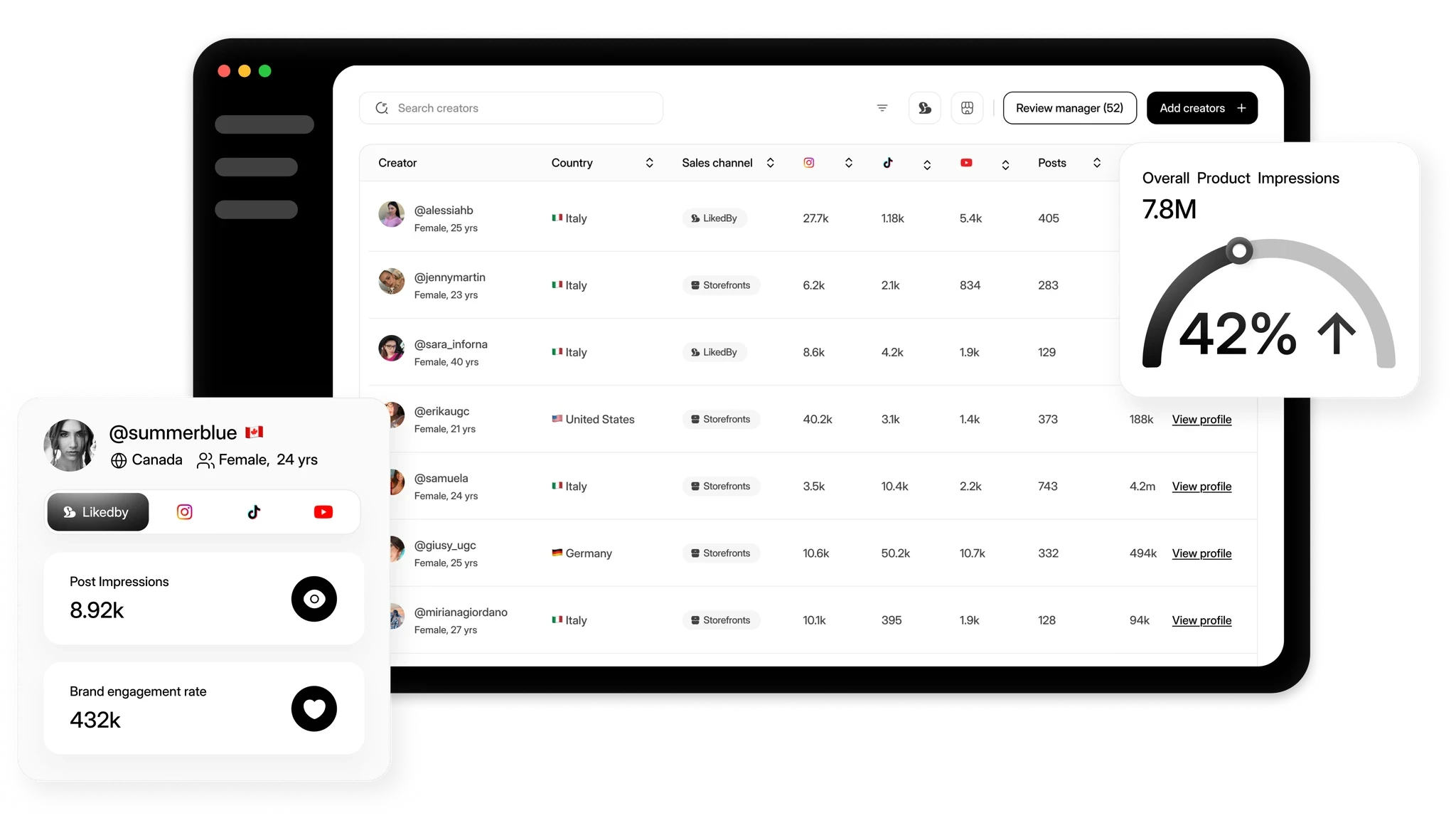
Socialscale's Creator Drive is a purpose-built content library designed for teams that manage high volumes of creator content across multiple clients and campaigns. Every asset uploaded or delivered through a collaboration is automatically tagged with creator identity, campaign association, client account, content format, and approval status. This means your team can search, filter, and retrieve any piece of content in seconds rather than minutes.
But Creator Drive does not operate in isolation. It is deeply integrated with Socialscale's creator collaborations workflow, so content delivered through a campaign brief flows directly into the drive with full context attached. There is no manual upload step, no copy-pasting file links, and no risk of orphaned assets sitting in a creator's email thread.
For performance agencies specifically, the value multiplies when Creator Drive connects to creator analytics. You can see which assets drove the strongest engagement, conversion, or revenue signals, and use that data to inform your next round of creative briefs. This closed loop between content storage, creator performance tracking, and campaign planning is what turns a file library into a strategic asset for your agency.
The platform also supports granular permission controls, so different team members and clients can access only the assets relevant to them. Account managers see their client's content. Media buyers see approved-for-paid assets. Creators see their own submissions. Everyone works from a single source of truth without compromising confidentiality across accounts.
Creator Drive Feature Breakdown for Performance Agencies
Auto-Organized Content Library
Every asset delivered through a Socialscale collaboration is automatically filed into the drive with metadata including creator name, campaign name, client account, content type (video, image, story, reel), aspect ratio, and delivery date. No manual sorting required. Your team opens the drive and filters to exactly what they need.
Advanced Search and Filtering
Filter assets by client, creator, campaign, content format, approval status, date range, or custom tags. When a media buyer needs three new vertical videos approved for paid use on a specific client account, they can surface those assets in under ten seconds.
Approval and Usage Rights Tracking
Each asset carries an approval status: pending review, approved for organic, approved for paid, revision requested, or expired. Account managers update statuses as content moves through the review process. Usage right expiration dates trigger alerts so your team never runs content past its authorized window.
Version History and Revision Management
When a creator submits a revised cut, the new version is linked to the original asset. Your team can compare versions side by side, and only the latest approved version appears in filtered searches for media buyers. Previous versions remain accessible for reference but do not clutter the active library.
Client-Level Workspaces
Performance agencies manage multiple clients, each with their own creator roster and campaign calendar. Creator Drive supports client-level workspaces so assets are compartmentalized. Team members assigned to a client see only that client's content, reducing noise and protecting confidentiality.
Bulk Download and Export
Media buyers often need to download batches of approved assets for upload into ad managers. Creator Drive supports bulk selection and download with original file quality preserved. Export packages can include metadata sheets for easy reference during campaign setup.
Content Performance Annotations
When integrated with Socialscale's analytics layer, assets in the drive can display performance annotations showing engagement rate, click-through rate, or conversion data from previous deployments. This helps creative strategists identify winning content patterns without switching between tools.
Creator Attribution and Content Provenance
Every asset is permanently linked to its creator profile in the creator CRM. This means you can trace any piece of content back to the creator who produced it, the brief they responded to, and the compensation they received. This is critical for agencies managing affiliate creator programs where content reuse and royalty tracking matter.
Use Cases: How Performance Agencies Use Creator Drive
Rapid Creative Testing Across Paid Channels
A performance agency managing paid social for a DTC skincare brand needs to test 20 new UGC variations every two weeks across Meta and TikTok. The creative strategist opens Creator Drive, filters for approved vertical videos from the current campaign, selects the top candidates based on content performance annotations, and bulk downloads them for the media buying team. What previously took a full morning of searching and verifying now takes 15 minutes. The agency maintains a two-week testing cadence without adding headcount.
Multi-Client Content Audits for Quarterly Business Reviews
At the end of each quarter, account directors need to present content volume, creator output, and creative performance to each client. Using Creator Drive's client-level workspaces, the account team filters all content delivered during the quarter, reviews approval statuses, and exports a content summary. Combined with performance data, this creates a comprehensive QBR deck that demonstrates the agency's value in concrete terms: number of assets produced, percentage approved on first submission, and top-performing creatives by ROAS.
Scaling a Whitelisting Program with Usage Rights Compliance
An agency running creator whitelisting campaigns for a fitness apparel brand needs to ensure every piece of content running as a paid ad has valid usage rights. Creator Drive's approval and expiration tracking surfaces any assets approaching their usage window end date. The ops team receives alerts seven days before expiration, giving them time to negotiate extensions or pull the creative from rotation. This prevents compliance violations and protects both the agency and the brand.
Building a Shoppable Content Library for Social Commerce
A performance agency expanding into social commerce for a home goods client wants to populate creator storefronts and shoppable galleries with high-converting UGC. The team uses Creator Drive to identify top-performing lifestyle images and product demo videos, then pushes those assets into shoppable content widgets on the client's site. The drive serves as the single source of truth connecting creator content production to on-site revenue generation, closing the loop between UGC management and commerce outcomes.
Weekly Operational Workflow for Performance Agencies Using Creator Drive
Monday: Campaign Brief Distribution – The creative strategist finalizes briefs for the week's creator collaborations and distributes them through Socialscale's collaboration workflow. Each brief specifies deliverable formats, messaging angles, and usage rights requirements. Briefs are linked to client workspaces so all resulting content will auto-file correctly.
Tuesday–Wednesday: Content Delivery and Auto-Filing – Creators submit deliverables through the platform. Each asset is automatically ingested into Creator Drive with full metadata: creator name, campaign, client, format, and submission date. No manual upload or folder sorting is needed.
Wednesday: Content Review and Approval – Account managers review submitted content within Creator Drive. They approve assets for organic use, paid amplification, or request revisions. Revision requests are sent back to creators with specific notes. Approved assets are immediately visible to media buyers through filtered views.
Thursday: Media Buyer Asset Pull – Media buyers filter Creator Drive for newly approved paid-ready assets. They bulk download selected creatives and upload them into Meta Ads Manager, TikTok Ads Manager, or other platforms. Performance annotations from previous campaigns inform which creative styles to prioritize in new ad sets.
Friday: Performance Tagging and Reporting – The analytics team reviews early performance signals from launched creatives. Top performers are tagged in Creator Drive for future reference. Underperformers are noted so the creative strategist can adjust next week's briefs. A weekly content velocity report is generated showing assets delivered, approved, and deployed per client.
Monthly: Content Audit and Rights Review – On the first Monday of each month, the ops team runs a usage rights audit across all client workspaces. Assets approaching expiration are flagged. The team contacts creators for renewals or schedules creative replacements. This prevents any lapse in paid content authorization.
Monthly: Client Content Summary – Account directors export content summaries from Creator Drive for each client. These summaries include total assets produced, approval rates, revision rates, and top-performing content. This data feeds into monthly performance reports alongside media buying metrics.
Key Performance Indicators for Performance Agencies Using Creator Drive
Tracking the right metrics ensures your agency extracts maximum value from Creator Drive. Here are the KPIs that matter most:
Asset Retrieval Time: Average time from search initiation to asset download. Target: under 30 seconds for any single asset.
Content Approval Turnaround: Time from creator submission to final approval status. Target: under 24 hours for first review pass.
First-Pass Approval Rate: Percentage of creator deliverables approved without revision requests. Higher rates indicate better briefing quality.
Creative Testing Velocity: Number of new UGC variations deployed to paid channels per week per client. Target: 10–25 new creatives per client per two-week cycle.
Content Output Per Creator: Average number of approved assets delivered per creator per month. Helps identify high-output creators for repeat collaborations.
Click-Through Rate (CTR) by Creative: CTR of paid ads using Creator Drive assets, tracked via performance annotations.
Conversion Rate (CVR) by Creative: On-site conversion rate attributed to specific creator content deployed through ads or shoppable widgets.
Return on Ad Spend (ROAS) by Creative: Revenue generated per dollar spent on ads featuring specific creator assets.
Cost Per Acquisition (CPA) by Creative: Acquisition cost for ads using specific UGC variations, enabling creative-level CPA optimization.
GMV/Revenue from Shoppable Content: Revenue generated through shoppable creator content embedded on client storefronts.
Usage Rights Compliance Rate: Percentage of active paid creatives with valid, unexpired usage rights. Target: 100%.
Creator Activation Rate: Percentage of onboarded creators who have delivered at least one approved asset within 30 days of onboarding.
Scenario: Mid-Size Performance Agency Scaling UGC Testing Across Seven Clients
A 25-person performance agency specializing in DTC e-commerce manages paid social and creator programs for seven clients across beauty, fitness, and home categories. Before implementing Creator Drive, the agency relied on a combination of Google Drive, Slack messages, and a shared spreadsheet to track creator deliverables. The creative operations coordinator spent approximately 12 hours per week locating, organizing, and distributing assets to media buyers.
The agency's core problem was creative testing velocity. Media buyers needed 15–20 new UGC variations per client every two weeks, but the asset retrieval process was so slow that they were only deploying 8–10 new creatives per cycle. Stale creatives led to rising CPAs and declining ROAS across multiple accounts.
After migrating to Creator Drive, the agency established client-level workspaces for all seven accounts. Creator collaborations were managed through Socialscale, so all deliverables auto-filed into the drive with complete metadata. The creative ops coordinator's weekly file management time dropped from 12 hours to under 3 hours.
Within six weeks, the agency saw measurable improvements. Creative testing velocity increased from an average of 9 new creatives per client per cycle to 22. Media buyers reported that asset retrieval time dropped from an average of 8 minutes per asset to under 20 seconds. The first-pass approval rate improved from 61% to 78% because the feedback loop between performance data and creative briefs tightened.
On the performance side, average CPA across all client accounts decreased by 17% over the first quarter of using Creator Drive, attributed primarily to faster creative refreshes and better-informed creative selection. One client's ROAS improved from 3.2x to 4.1x after the agency began using performance annotations to prioritize top-performing content styles in new briefs. The agency also eliminated two compliance incidents per quarter related to expired usage rights, thanks to automated expiration alerts.
The agency now uses Creator Drive as the centerpiece of its creative operations, with account directors pulling content summaries directly from the platform for client QBRs. The operations team estimates that Creator Drive saves the equivalent of one full-time coordinator role across the agency.
Frequently Asked Questions
How does Creator Drive differ from using Google Drive or Dropbox for UGC management?
Creator Drive is purpose-built for creator content workflows. Unlike generic cloud storage, every asset is automatically tagged with creator identity, campaign association, client account, content format, and approval status. You can filter and search by any of these dimensions instantly. Google Drive and Dropbox have no concept of a creator, a campaign, or a usage right, which means your team builds and maintains folder structures manually. At scale, this breaks down and costs significant operational hours.
Can we manage multiple client accounts within a single Creator Drive instance?
Yes. Creator Drive supports client-level workspaces, so each client's content is compartmentalized. Team members see only the clients they are assigned to, and there is no risk of cross-contamination between accounts. This is essential for performance agencies managing competitive or overlapping categories.
How does Creator Drive handle usage rights and content approval for paid amplification?
Each asset in Creator Drive carries an approval status that can be set to pending review, approved for organic, approved for paid, revision requested, or expired. Usage right expiration dates can be attached to any asset, and the system sends alerts before expiration. This ensures your media buying team never runs content past its authorized usage window, protecting both your agency and your clients.
Does Creator Drive integrate with ad managers like Meta Ads Manager or TikTok Ads Manager?
Creator Drive does not push assets directly into ad managers. However, it supports bulk download and export with preserved file quality and metadata sheets that align with common ad manager naming conventions. This makes the handoff from content library to ad platform fast and organized. The workflow is designed to minimize manual steps during campaign setup.
How does Creator Drive connect to creator performance tracking?
When used alongside Socialscale's analytics capabilities, assets in Creator Drive can display performance annotations showing engagement rate, CTR, conversion rate, and revenue data from previous deployments. This allows creative strategists to identify winning content patterns directly within the content library, without switching between multiple tools. The closed loop between content storage and performance data is what makes Creator Drive a strategic tool rather than just a file repository.